
Data annotation is the process of labelling raw data — images, text, audio, video, or sensor data — so that a machine learning model can learn to recognise patterns in it. Without labelled examples to learn from, a model has no way to connect what it’s looking at with what that thing actually means. This single step, more than model architecture or compute budget, tends to decide whether an AI project performs well in production or quietly underperforms for reasons nobody can quite pin down.
This article covers what annotation actually involves, the different types depending on your data modality, where teams commonly go wrong, and what a sensible implementation approach looks like once you move past the pilot stage.
Why Annotation Quality Determines Model Performance
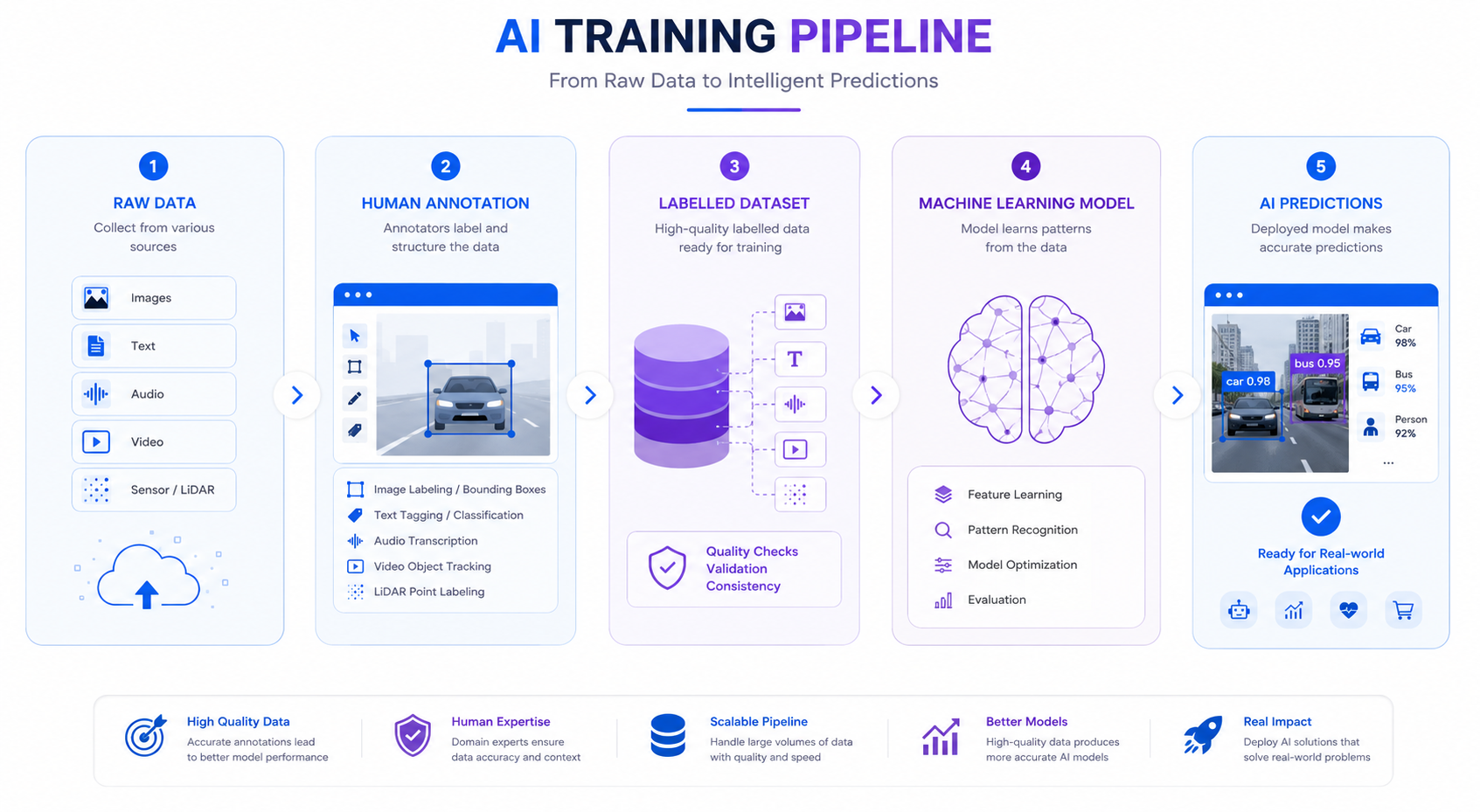
The complete AI training pipeline from raw data collection to intelligent predictions.
A model trained on inconsistently labelled data will produce inconsistent predictions, regardless of how sophisticated the underlying architecture is. This is one of the more counterintuitive lessons teams learn the hard way — a lot of engineering effort goes into model selection and hyperparameter tuning, while the dataset that actually shapes the model’s behaviour gets far less scrutiny.
A few concrete failure patterns show up repeatedly:
- A product classifier confuses two visually similar SKUs because the training examples weren’t distinguished with enough granularity during labelling.
- A Named Entity Recognition model tags “Apple” as an organisation in every sentence, including ones about the fruit, because annotation guidelines never addressed that ambiguity.
- A defect-detection model in manufacturing flags false positives on shadows or reflections because annotators weren’t given clear rules on what counts as a genuine surface defect versus a lighting artefact.
Each of these traces back to the same root cause: annotation guidelines that were either too vague or never tested against edge cases before large-scale labelling began. In our experience reviewing annotation pipelines across different projects, the guideline document is usually the weakest link, not the annotators executing it.
One lesson that becomes obvious during implementation: annotation is not a one-time task. Models drift as real-world data shifts, new edge cases surface after deployment, and most serious ML teams end up returning to labelling multiple times across a model’s lifecycle. Budgeting for annotation as a single upfront cost, rather than an ongoing operational expense, is a mistake that catches a lot of teams off guard around month six or seven of a project.
Types of Data Annotation
The right annotation technique depends on the data modality and the specific problem the model needs to solve. The table below gives a quick comparison before the detailed breakdown.
| Data Type | Common Techniques | Typical Output Format |
|---|---|---|
| Images | Bounding boxes, polygon annotation, semantic segmentation, instance segmentation | COCO JSON, Pascal VOC XML |
| Text | Named Entity Recognition, sentiment tagging, intent classification, OCR annotation | JSON/CoNLL, tagged spans |
| Audio | Speech transcription, speaker diarization, sound event tagging | Timestamped transcripts (SRT/VTT-style) |
| Video | Object tracking across frames, event/action tagging | Frame-indexed bounding boxes |
| 3D/Sensor | LiDAR point cloud annotation, radar labelling | 3D bounding boxes, point cloud segments |
Image Annotation
Bounding boxes are the simplest technique — a rectangle drawn around an object, sufficient for tasks like counting vehicles in a traffic camera feed. Polygon annotation traces irregular shapes more precisely, which matters when the exact boundary is relevant, such as marking hail damage on a car body panel for an insurance claim assessment. Semantic segmentation classifies every pixel into a category (road, sky, building), while instance segmentation goes further by separating individual objects within the same category — relevant when a warehouse inventory system needs to count each carton on a pallet separately rather than label the pallet as one object.
Annotation format matters here more than most teams expect. COCO and Pascal VOC are two widely used standard formats, and choosing one over the other early on can save considerable rework later if you plan to use pre-trained models or open-source training pipelines built around a specific format.
Text Annotation
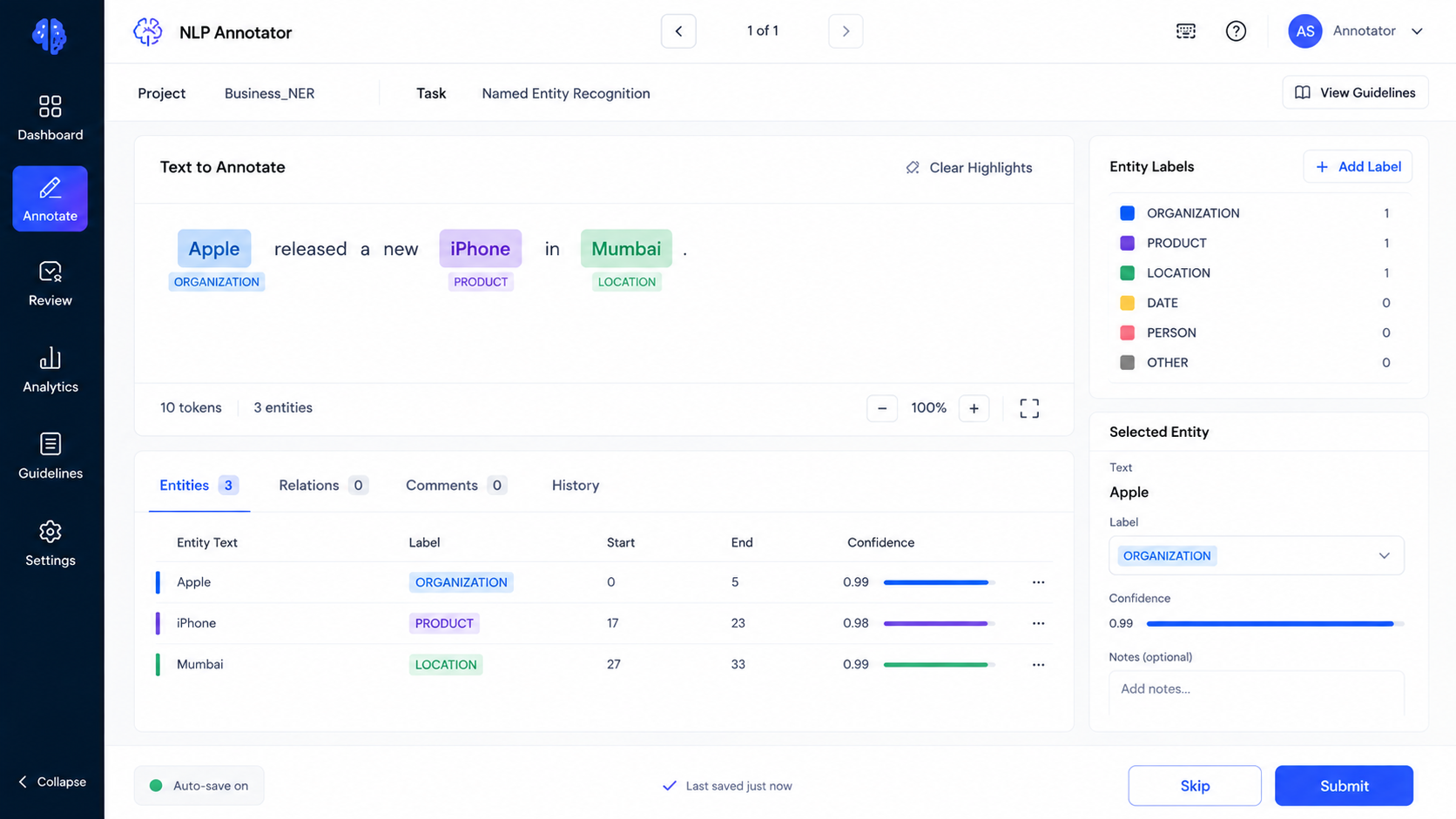
Named Entity Recognition (NER) annotation for natural language processing.
Named Entity Recognition tags specific words or phrases as people, organisations, locations, or custom categories relevant to the business — useful for extracting supplier names and contract values from procurement documents, for example. Sentiment and intent tagging support customer feedback analysis and support ticket routing. OCR annotation is a distinct task from NER — it involves labelling text regions within scanned images so a model learns to extract characters accurately, which matters for anything involving invoices, ID documents, or handwritten forms.
Text annotation is deceptively difficult to standardise because language is genuinely ambiguous. Two competent annotators can disagree on whether a sentence is neutral or mildly negative, and no amount of guideline-writing eliminates that entirely — it just narrows the disagreement.
Audio Annotation
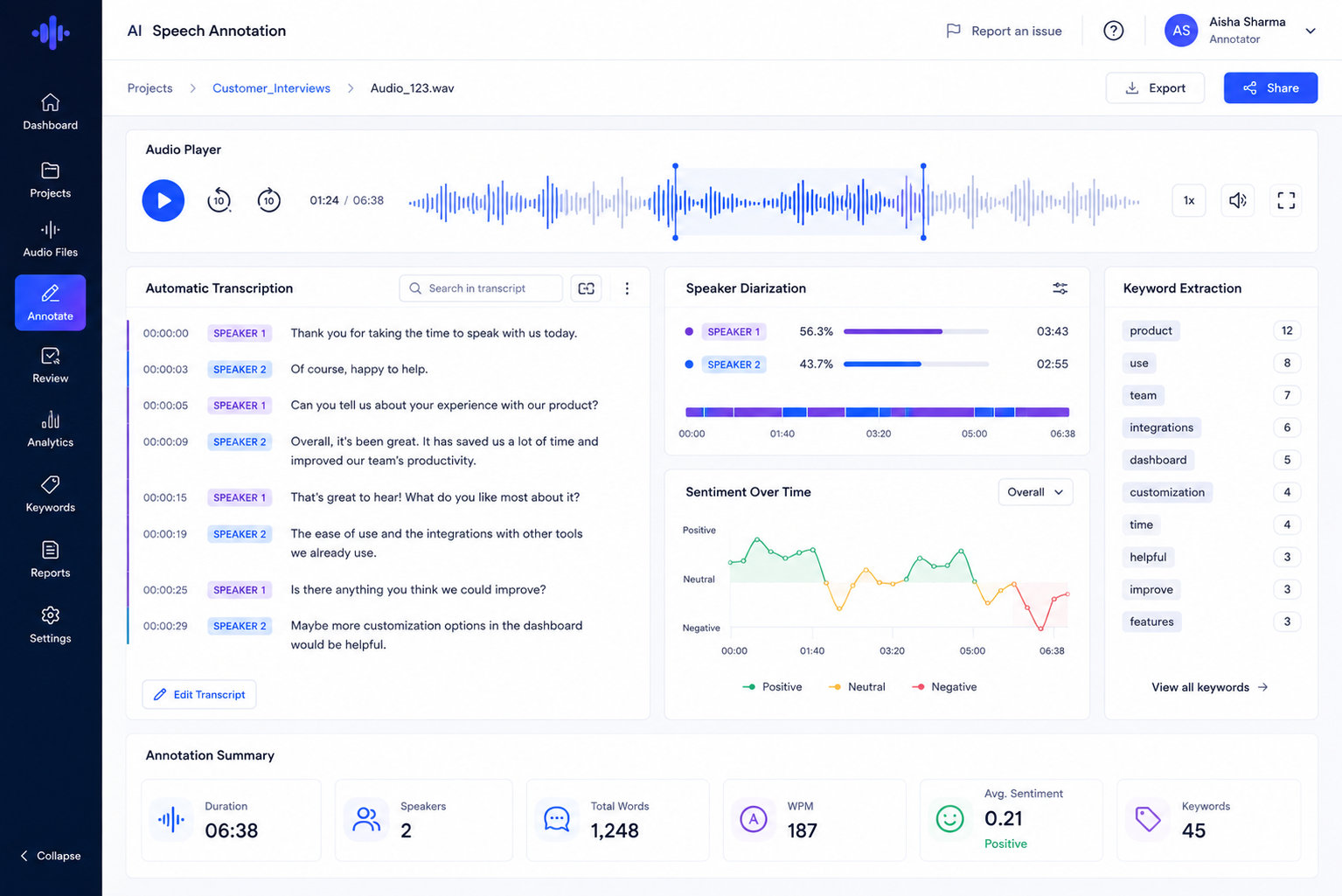
AI speech annotation interface for preparing voice datasets.
Speech transcription converts spoken audio into text, forming the backbone of voice assistants and call centre analytics. Speaker diarization identifies who is speaking and when, which matters for multi-speaker recordings like meeting transcripts or customer service calls. An accent, regional dialect, or background noise pattern that annotators didn’t account for while building guidelines can quietly degrade transcription accuracy for specific user segments — this is a common blind spot in audio annotation projects that aim for broad geographic coverage.
Video Annotation
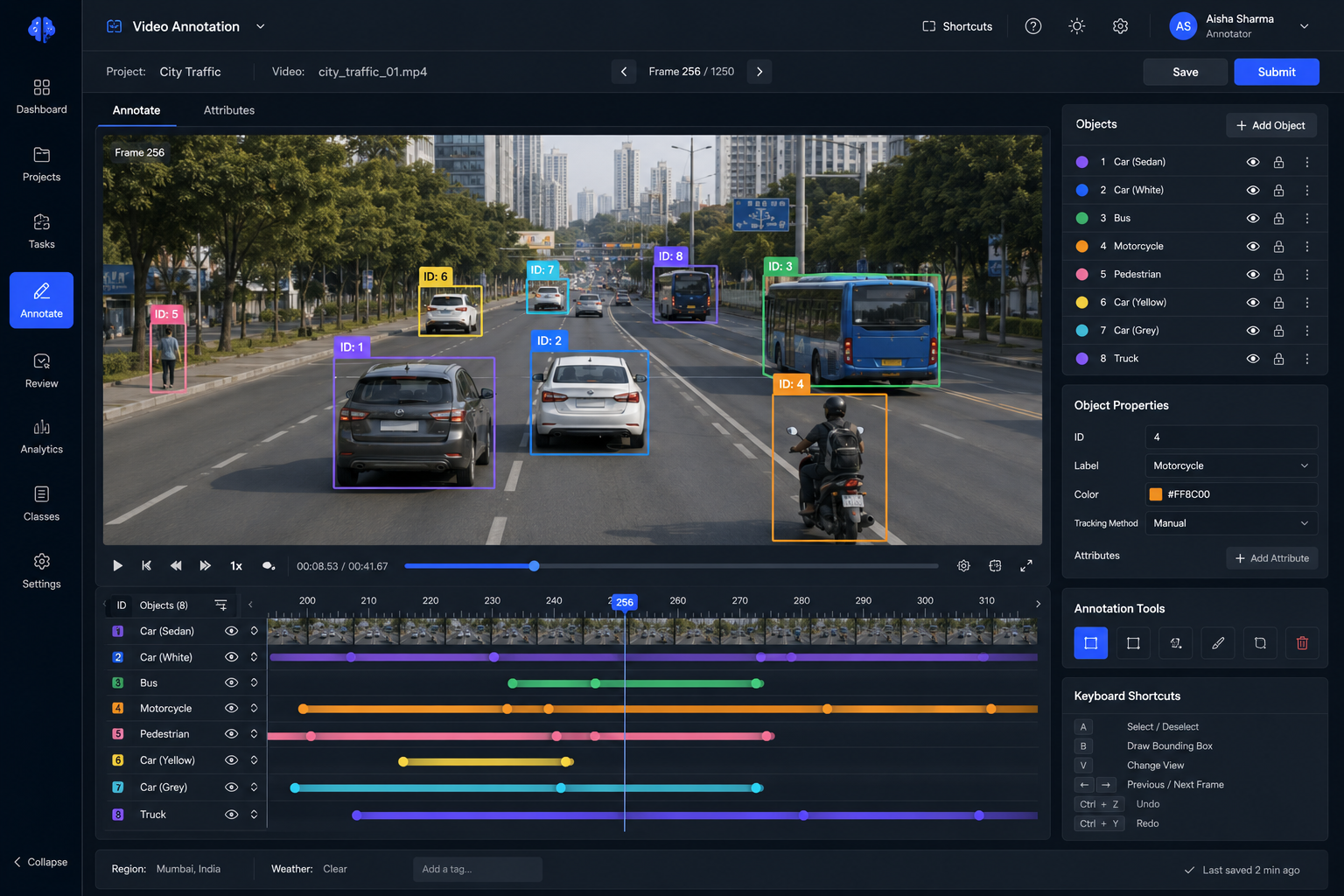
Video annotation extends image annotation into the time dimension — tracking an object’s position and behaviour across consecutive frames rather than a single still. This underpins sports performance analytics (tracking player movement across a match) and security systems monitoring for specific events over time, such as a person entering a restricted zone.
LiDAR and 3D Point Cloud Annotation
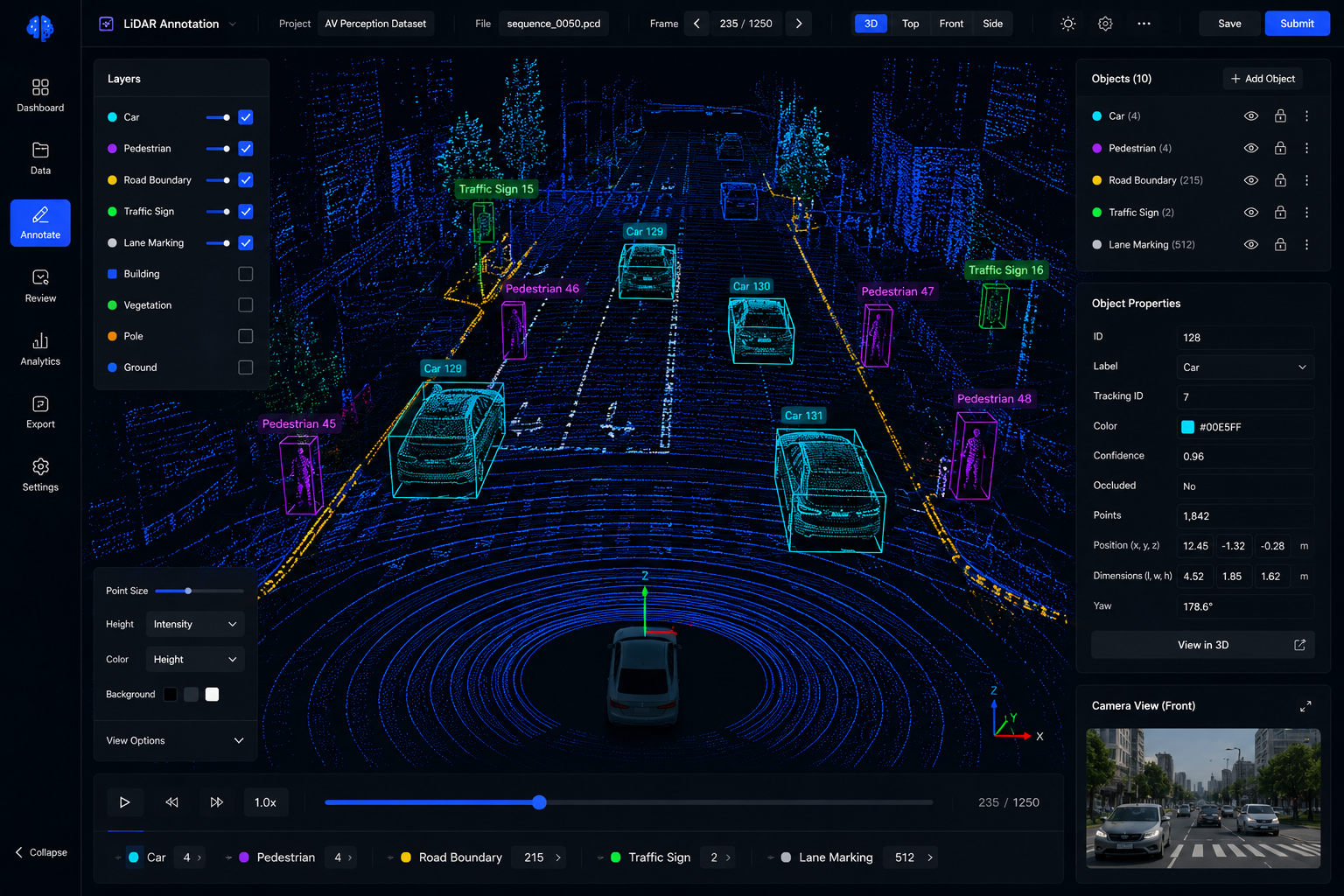
Less commonly discussed, but increasingly relevant for autonomous vehicles and industrial robotics, LiDAR annotation involves labelling three-dimensional point cloud data rather than flat images — identifying object boundaries, distances, and orientation in 3D space. This requires specialised tooling and annotators comfortable working with spatial data, and the talent pool for this is considerably smaller than for standard image or text annotation.
Common Mistakes Companies Make
- Skipping a pilot batch. Jumping straight into large-scale annotation without first testing guidelines on a small sample means errors get baked into thousands of labels before anyone notices the guideline gap.
- Treating annotators as interchangeable. Domain-specific tasks — medical imaging, legal clauses, financial documents — need annotators with relevant background knowledge, not just general labelling experience.
- No measurement of labelling consistency. Without tracking inter-annotator agreement (how often independent annotators arrive at the same label for the same data point), inconsistency goes unnoticed until model performance dips.
- Ignoring edge cases during guideline creation. Guidelines that only cover the obvious cases leave annotators guessing on the ambiguous ones, and different annotators guess differently.
- Underestimating ongoing annotation needs. Treating labelling as a one-time project cost rather than a recurring operational one, which causes budget and timeline surprises during model retraining cycles.
Challenges Beyond the Obvious
Data privacy deserves more attention than it typically gets in annotation planning. A lot of the data that most needs labelling — medical records, financial documents, biometric data, internal HR records — is also the kind of data organisations are legally obligated to protect. Annotation workflows touching sensitive data need access controls, anonymisation where feasible, and audit trails built in from the start, not retrofitted after a compliance review raises a flag.
Cost and scalability trade-offs are another underdiscussed area. Fully manual annotation gives the highest accuracy for genuinely novel or ambiguous data but doesn’t scale economically once volumes climb into the millions of examples. Fully automated pre-labelling scales cheaply but risks systematic errors propagating silently through the dataset, particularly if annotators start approving model suggestions without genuinely reviewing them — a pattern sometimes called automation bias in QA circles. Most mature annotation pipelines land somewhere on a spectrum between these two, rather than at either extreme.
| Approach | Accuracy | Cost at Scale | Best Suited For |
|---|---|---|---|
| Fully manual | Highest | High | Novel data, ambiguous edge cases, small datasets |
| Semi-automated (human-in-the-loop) | High, with review overhead | Moderate | Most production pipelines needing scale and accuracy |
| Fully automated/pre-labelled | Variable, risk of drift | Low | Well-understood, low-ambiguity tasks with strong QA |
How Businesses Can Approach This More Deliberately
A decision framework that tends to work in practice:
- Start with a pilot batch (200–500 samples) to stress-test guidelines against real edge cases before scaling up.
- Measure inter-annotator agreement on that pilot batch. Low agreement signals a guideline problem, not an annotator problem — fix the guidelines before scaling.
- Choose your automation level deliberately, based on the accuracy-versus-cost table above, rather than defaulting to whichever tool your team already has access to.
- Build in QA checkpoints at intervals, not just at project completion — periodic audits and repeat agreement checks catch labelling drift before it reaches the model.
- Assign domain experts to specialised categories, even if that means a smaller, more expensive annotator pool for that specific subset of data.
- Document data handling protocols explicitly wherever sensitive data is involved, and treat this as a design requirement, not an afterthought.
Tools like CVAT, Labelbox, and Amazon SageMaker Ground Truth are commonly used to manage annotation workflows and can help operationalise several of these steps — pre-labelling, review queues, and agreement tracking are often built into these platforms rather than needing to be built from scratch.
Mini FAQ
Is data annotation the same as data labelling?
The terms are generally used interchangeably in industry. Some teams use “labelling” for simpler categorical tasks and “annotation” for more detailed work like bounding boxes or segmentation, but there’s no strict technical distinction.
How much labelled data does a model actually need?
This varies enormously by task complexity and model type, and any specific number quoted without context should be treated with scepticism. A simple binary text classifier may work reasonably with a few thousand well-labelled examples, while a segmentation model for a complex visual task may need considerably more. The realistic answer is to start with a pilot dataset, evaluate model performance, and scale up based on observed accuracy gaps rather than a fixed target.
Should annotation be done in-house or outsourced?
It depends on data sensitivity, required domain expertise, and volume. Highly sensitive or specialised data (medical, legal) often benefits from a smaller in-house or vetted specialist team, while high-volume, lower-sensitivity tasks are frequently outsourced to annotation vendors with established QA processes.
Glossary
- Bounding box – A rectangular region drawn around an object to indicate its location within an image or video frame.
- Semantic segmentation – Classifying every pixel in an image into a category, without distinguishing between individual object instances.
- Instance segmentation – Like semantic segmentation, but separating individual objects within the same category.
- Inter-annotator agreement – A measure of how consistently independent annotators label the same data, used to assess guideline clarity and data quality.
- Human-in-the-loop – A workflow where a model generates initial predictions or labels, and a human reviews or corrects them before they’re finalised.
- NER (Named Entity Recognition) – Identifying and classifying specific entities (people, organisations, locations) within text.
- Ground truth – The verified, correct label against which model predictions are measured.
Closing Thoughts
Annotation sits upstream of the more visible parts of an ML project — model training, evaluation, deployment — and it rarely gets the planning attention those later stages receive. But the reliability of everything downstream depends on it. Teams that treat guideline design, agreement measurement, and ongoing QA as core parts of the ML workflow, rather than a one-time outsourced task, tend to end up with models that behave more predictably once real users start relying on them.
Be the first to comment on "What is Data Annotation? Types, Role, Challenges and Solutions Explained"